Choosing between granite and quartz countertops? We break down the key differences to help you make the right decision for your kitchen.
Share:

Summary:
Granite countertops come from pure natural stone, quarried directly from the earth and cut into slabs. Each piece tells its own geological story, formed over millions of years through volcanic activity and mineral deposits.
Quartz countertops take a different approach. They’re engineered from about 93% crushed natural quartz crystals combined with polymer resins and pigments. This manufacturing process creates consistent patterns and allows for color customization that natural stone can’t match.
Both materials deliver premium quality, but their origins shape everything from appearance to maintenance requirements. Understanding these fundamental differences sets the foundation for making the right choice for your kitchen.
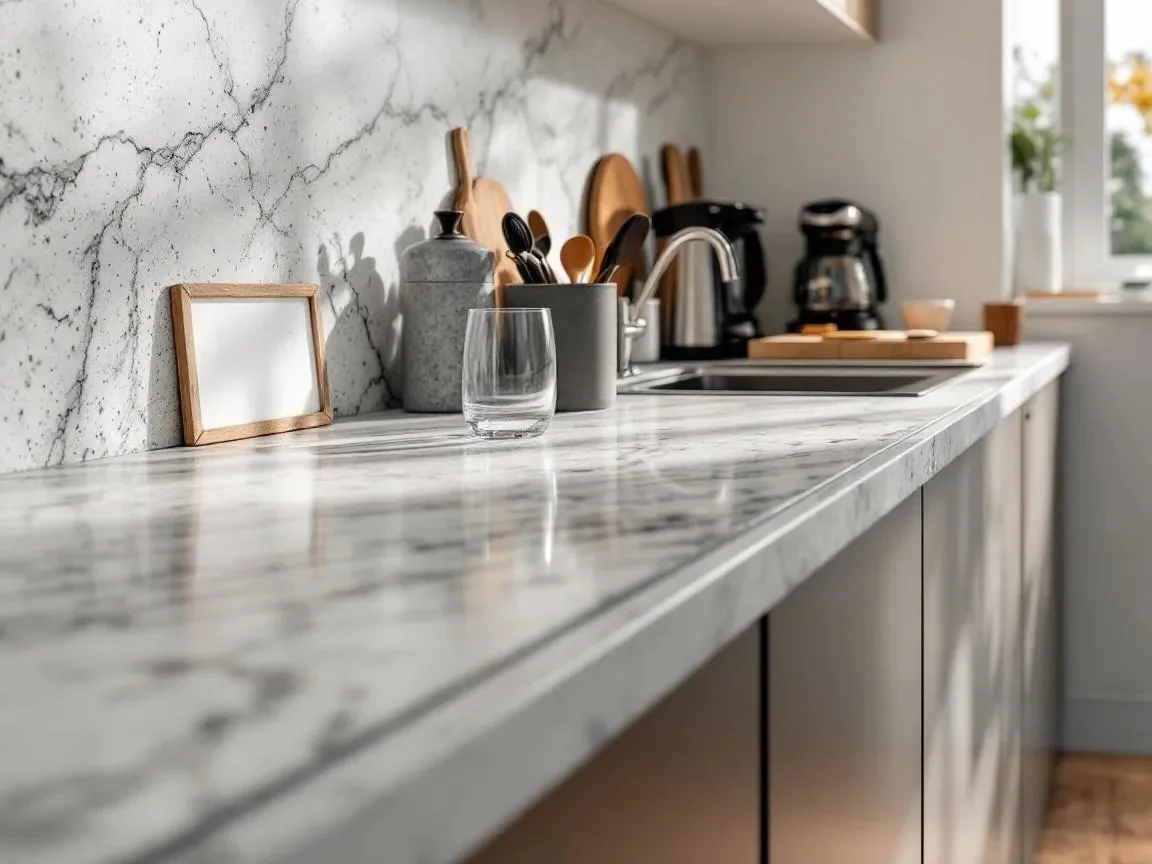
Granite’s natural formation creates unique veining, mineral inclusions, and color variations that make every slab one-of-a-kind. You’ll never find two identical pieces, which appeals to homeowners who want something truly distinctive. The natural patterns range from subtle earth tones to dramatic swirls with bold colors.
However, this uniqueness comes with considerations. Matching slabs for larger installations can be challenging, and visible seams may require careful planning during design.
Quartz offers the opposite approach with engineered consistency. Manufacturers can create uniform patterns and colors that remain consistent across multiple slabs. This makes seam placement less noticeable and simplifies installation planning.
The trade-off is a more manufactured appearance that some find less authentic than natural stone. Modern quartz has improved dramatically, with many options that closely mimic natural granite and marble patterns.
For Smith County homes with open-concept layouts, quartz’s consistency often works better for large islands or extended countertop runs where uniform appearance matters most.
Granite’s natural formation creates unique veining, mineral inclusions, and color variations that make every slab one-of-a-kind. You’ll never find two identical pieces, which appeals to homeowners who want something truly distinctive. The natural patterns range from subtle earth tones to dramatic swirls with bold colors.
However, this uniqueness comes with considerations. Matching slabs for larger installations can be challenging, and visible seams may require careful planning during design.
Quartz offers the opposite approach with engineered consistency. Manufacturers can create uniform patterns and colors that remain consistent across multiple slabs. This makes seam placement less noticeable and simplifies installation planning.
The trade-off is a more manufactured appearance that some find less authentic than natural stone. Modern quartz has improved dramatically, with many options that closely mimic natural granite and marble patterns.
For Smith County homes with open-concept layouts, quartz’s consistency often works better for large islands or extended countertop runs where uniform appearance matters most.
Want live answers?
Connect with a Rapid Granite expert for fast, friendly support.
The maintenance difference between granite and quartz significantly impacts daily life and long-term costs. Understanding these requirements helps you choose the material that fits your lifestyle and maintenance preferences.
Granite requires periodic sealing to maintain its stain resistance. Most installations need resealing every 1-2 years, depending on usage patterns. This process takes about an hour and involves applying a penetrating sealer that protects against moisture and stains.
Quartz eliminates sealing entirely. The non-porous surface resists stains naturally and requires only regular cleaning with mild soap and water. This makes quartz appealing for busy households who prefer minimal maintenance routines.
Daily care routines differ between these materials in ways that affect your kitchen experience. Granite cleaning requires avoiding acidic substances like lemon juice, vinegar, or wine that can etch the surface over time. pH-neutral cleaners work best for maintaining the stone’s integrity and appearance.
The natural porosity means spills should be cleaned promptly to prevent staining. While properly sealed granite resists most stains, immediate cleanup prevents any potential issues.
Quartz simplifies daily maintenance significantly. The non-porous surface handles acidic spills without etching, and most stains wipe away easily with standard household cleaners. You can use glass cleaners, all-purpose cleaners, or simple soap and water without concern.
However, quartz does require protection from excessive heat. Always use trivets for hot cookware, and avoid placing heated appliances directly on the surface.
For Smith County families with busy schedules, quartz’s simplified maintenance often outweighs granite’s heat advantages. The time saved on sealing and careful cleaning adds up over years of use.
Both materials benefit from using cutting boards to prevent knife damage and maintaining reasonable care during daily use. Neither requires special cleaning products or professional maintenance beyond the occasional granite sealing.
Pricing for both materials varies based on quality grades, color selection, and installation complexity. In Smith County, granite typically costs between $40-70 per square foot installed for mid-grade options, while premium varieties can reach $100-150 per square foot.
Quartz pricing ranges from $50-75 per square foot for standard options, with premium engineered varieties reaching $100-200 per square foot. The installed cost often depends more on specific slab selection than material type.
Both materials add significant value to Smith County homes. Real estate professionals consistently rank quality countertops among the most desirable features for potential buyers. Granite installations typically recoup 70-80% of their cost at resale, while quartz offers similar returns.
The long-term value calculation includes maintenance costs. Granite’s periodic sealing adds minimal expense over time, while quartz eliminates this ongoing cost entirely. For most homeowners, the maintenance difference doesn’t significantly impact total ownership costs.
Installation complexity affects pricing more than material choice. Both require professional installation due to weight and precision requirements. Complex layouts with multiple seams, cutouts for sinks and appliances, or custom edge profiles increase costs regardless of material selection.
Consider your planned time in the home when evaluating costs. Short-term residents might prioritize lower upfront costs, while long-term homeowners often benefit from investing in premium materials that provide decades of satisfaction.
The choice between granite and quartz ultimately depends on your priorities, lifestyle, and aesthetic preferences. Granite appeals to homeowners who value natural beauty, superior heat resistance, and don’t mind periodic maintenance. Quartz works better for busy families prioritizing easy care, consistent appearance, and stain resistance.
Consider how you actually use your kitchen daily rather than how you imagine using it. Serious cooks who frequently use high heat often prefer granite’s thermal properties. Families with young children might appreciate quartz’s stain resistance and easy cleanup.
Both materials will serve your Smith County home beautifully for decades with proper care. The key is choosing the option that best fits your lifestyle and brings you daily satisfaction. When you’re ready to move forward, we can help you explore both options and make the choice that’s right for your home.
Article details:
Share:
Continue learning: